Serving the Whole Person: Tech’s Role in Building Belonging within Catholic Schools

Catholic education has always recognized the whole person— in mind, body, and spirit. The mission is larger than academics or athletics; it’s anchored in the belief of forming students who know they are loved, seen, and part of something greater than themselves. That sense of belonging takes daily effort to build and sustain.
Belonging is not only formed during retreats, assemblies, or homeroom prayers. It’s built in the everyday interactions with students, families, and staff alike, through a kind word from a teacher, a note home from a campus minister, or a timely reminder from the front office.
Increasingly, those interactions happen online, and families and students now expect to connect quickly and meaningfully, and they want communications that are responsive, personal, and human.
At the same time, many Catholic schools are navigating enrollment challenges. Although there’s been some stabilization and even a small rebound since the pandemic, the U.S. has seen a 14% decline in Catholic school enrollment over the past decade. As schools work to attract and retain mission-aligned families, meaningful connections will be essential.
This is where technology plays an important role. When used with purpose, digital tools become a quiet partner, helping you build trust, invite engagement, and serve each student and family in a way that feels personal—a major influence in supporting enrollment and retention efforts.
In fact, a student’s sense of belonging improves academic outcomes, supports mental health, and increases the likelihood they’ll stay enrolled.
Belonging starts with connection, and technology can help make those connections easier to start and easier to keep.
Building Trust from Day One with Technology
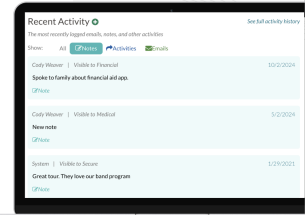
This focus on building and sustaining relationships is why an enrollment management system (EMS) has become the digital backbone for attracting new families. An EMS lets your staff manage inquiries, track personalized communications, and nurture prospective families from their first touchpoint, all the way through to enrollment. And with all your enrollment-focused communication in one place, every follow-up with families is timely, relevant, and personal.
What was a transactional application process now becomes a relationship-building moment that reflects your school’s care and commitment to the whole family.
Leading with Care, Even When You’re Not in the Room
It doesn’t matter whether you’re leading a morning assembly, attending Mass with students, or walking the halls between periods; your presence communicates care, stability, and connection. But as responsibilities grow and schedules fill, it becomes increasingly difficult to be physically present in every moment that matters.
Tools like two-way messaging, role-based portals, and mobile notifications can support that presence. They help you reach students, staff, and families using their preferred channels and preferred language, so whether you’re communicating a schedule change, promoting a service project, or sharing a prayer before finals, every message becomes a point of connection, and your communications become an extension of your leadership.
As Catholic school leaders, you’re already called to serve the whole person. With the right systems in place, you can extend that care into the daily lives of the people you serve, and make the most of the moments you can’t be in the room.
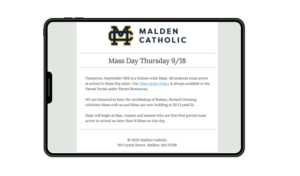
Malden Catholic in Massachusetts, for example, uses its mass communications tools to send out urgent messages, helpful reminders, and important announcements through email, text, voice, or mobile app notifications
Creating Space to Listen
In a Catholic school community, where formation happens in partnership with families, listening is one of the most powerful ways to serve the whole person.
Newsletters go out and alerts get posted, but too often, communications are a one-way street. When your families have simple and secure ways to respond through a private reply, a direct message to a teacher, or a note of thanks to the school leadership, Catholic leaders can create a respectful culture with tools that:
● Allow students to reach out directly, especially when they’re unsure or struggling.
● Give parents confidence that messages are received, moderated, and responded to thoughtfully.
● Make space for pastoral care to reach those who may not come forward in person.

Chat apps can support a sense of openness while maintaining appropriate boundaries and oversight. They help leaders protect staff time, student safety, and the quality of conversations, without adding layers of complexity.
Making It Personal: Communication That Says “I See You”
One of the most effective ways Catholic schools live their mission is by recognizing the inherent dignity of each person. It’s woven into how they teach, lead, and care for your communities, and in such a busy world, personalization is one way to say, “I see you.”
It’s easy for communication to feel generic, especially when schools manage updates across multiple grades, departments, and audiences, but when families receive messages that reflect their child’s experience, when students see content that speaks to them directly, the tone shifts.
With the right tools, you can do much of the work behind the scenes:
● Parents of middle schoolers see reminders that apply to them, not elementary field trips.
● Students get updates relevant to their classes, activities, or campus life.
● Teachers and staff receive updates that are timely, not overwhelming.
Catholic school leaders can use personalization to support the kind of relationships that often start in the front office, the classroom, or the chapel, and when that sense of care is reflected in your online experience, the effects are exponential.
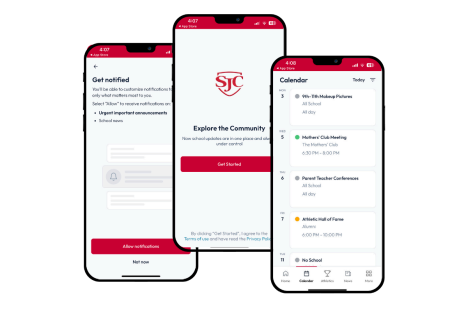
Just like D.C’s St. John’s College High School’s mobile app, many of the communication tools on the market offer personalization features that allow schools to tailor content by role, grade level, language, and location, making it easier to meet each member of your community where they are with personalized content and notifications.
Digital Communication with Intention
Every Catholic school has its own rhythm shaped by the liturgical calendar, the school’s traditions, and the values it upholds. That rhythm shows up in the way students pray together, how service is encouraged, and how the mission is woven into daily life.
Your communications should reflect that same care and clarity.
In a Catholic school, communication has the potential to carry something more—a sense of purpose. A reminder about a retreat, a parent note from the principal, or a message of encouragement are chances to reinforce the voice and values of your community.
Catholic school leaders can lead with intentionality by:
● Sending messages that speak not only to the “what” but the “why”
● Sharing reflections or scripture as part of weekly updates
● Scheduling important communications to align with liturgical milestones—Advent, Lent, feast days, or patronal celebrations
The tools you use can support this kind of communication, and help families see that your school’s mission is present in every part of the experience, even in an inbox or app. With built-in scheduling, role-based targeting, and message templates, your staff can create and share meaningful updates without starting from scratch.
Spiritual leadership happens in both big and small moments, and when your systems reflect the heart of your school, it’s easier for families to recognize and respond to it, giving you more opportunities to show who you are and who you’re serving.
Every message matters, and every interaction builds trust. In Catholic schools, that trust is the foundation for forming hearts and minds. Technology won’t replace the mission, but when used with care, it can reflect and strengthen it for every family.