A Framework for Catechesis in Catholic Schools
“Catholic schools are ecclesial entities. As such they participate in the evangelizing mission of the Church and represent the privileged environment in which Christian education is carried out.”
-The Identity of the Catholic School for a Culture of Dialogue
What does it truly mean to pass on our Catholic faith? In Catholic schools, we often speak of our mission to form saints. But what does that really entail? How does this mission shape the way we teach, or the activities in our hallways, classrooms, and extracurricular activities?
Too often, the mission of Catholic schools becomes confined to one small part of the school day – religion class, morning prayer, or the weekly school Mass – while the rest of the day focuses almost exclusively on preparing students for college, careers, and citizenship. This implicit separation between faith formation and secular education communicates to our students that preparation for the next level of education is essential, while faith is secondary.
Dr. Michael Naughton, director of the Center for Catholic Studies at the University of St. Thomas (Minnesota), describes this division with a striking metaphor: Is the faith in our Catholic schools simply frosting on the cake?1 In other words, is the secular education program the “cake,” with a thin layer of Catholic identity spread on top to make it sweet? If so, faith remains something added, not something integral.
We are challenged instead to make our Catholic faith the yeast in the bread. Flour, water, and salt can nourish, but they remain dense and unremarkable without yeast. Once added, the yeast transforms the entire loaf, bringing it to life, giving it aroma, beauty, and nourishment. The yeast does not turn the bread into more yeast; rather, it elevates what is already there. In the same way, our Catholic faith should animate and elevate every aspect of school life.
We cannot relegate the teaching of our faith solely to theology class. It must permeate everything we teach and everything we do. The Church expresses this clearly: “From the first moment that a student sets foot in a Catholic school, he or she ought to have the impression of entering a new environment, one illumined by the light of faith…an environment permeated with the Gospel spirit of love and freedom… If it is not present, then there is little left which can make the school Catholic.”2
Inspired by this call to translate the inspiration of Jesus “from the ideal into the real”3 the Archdiocese of Saint Paul and Minneapolis recently reassessed how our Catholic schools, in partnership with parents, catechize the children in their care. Through a study of Church teaching on Catholic education paired with guidance from the General Directory for Catechesis and the Institute of the Catechism’s Handbook on the Catechetical Accompaniment Process, the Archdiocesan Office for the Mission of Catholic Education developed a plan for catechesis to help our Catholic schools infuse the faith into every dimension of school life. From this work, we developed the four pillars of excellence in catechesis as a part of the Archdiocese’s Integrated Catholic Curriculum for Religion and Culture.
The four principles of student excellence are:
- Academic Achievement and Integration
- Virtue Formation and Human Development
- Spiritual Life
- Apostolic Discernment
These four principles can be envisioned as pillars, the structural posts of a building: distinct yet interdependent, together forming the framework of a vibrant, coherent Catholic culture in our schools. They allow the faith to “permeate all facets of the educational climate.” 3

Pillar One: Academic Achievement and Integration
We cannot love what we do not know. Catholic educators are called to form students’ intellectual understanding of God’s nature, His actions in history along with an understanding of the sacraments and Scriptures. Without an intellectual understanding of our faith, students cannot develop a sacramental vision of reality. Prayer and liturgy become meaningless, and faith is left weak and vulnerable. Theology instruction, therefore, must be both rigorous and engaging, taught by educators whose lives themselves bear witness to the faith they proclaim. Yet Catholic education requires more than excellent theology classes. Faith is not simply one subject alongside others; it is the light that allows every subject to be seen in its fullness. Through this lens, science reveals the beauty of creation, mathematics discloses the order woven into the universe, and history unfolds as a story marked by God’s providence. When faith permeates all areas of study, it leads students on a journey from wonder to wisdom.

Pillar Two: Virtue Formation and Human Development
A Catholic educational environment must be grounded in the Christian understanding of the human person. Students should come to know that they possess inherent dignity as beloved sons and daughters of God, and that the purpose of their life is to make a gift of themselves to God and to others, following the example of Christ.
To make a gift of oneself requires virtue, an excellence of character. Teachers, through their witness and through the examples of the saints, should integrate virtue into classroom management, instruction, and interactions with students and families. In Catholic schools, the language of virtue must become the primary language of formation.
Pillar Three: Spiritual Life
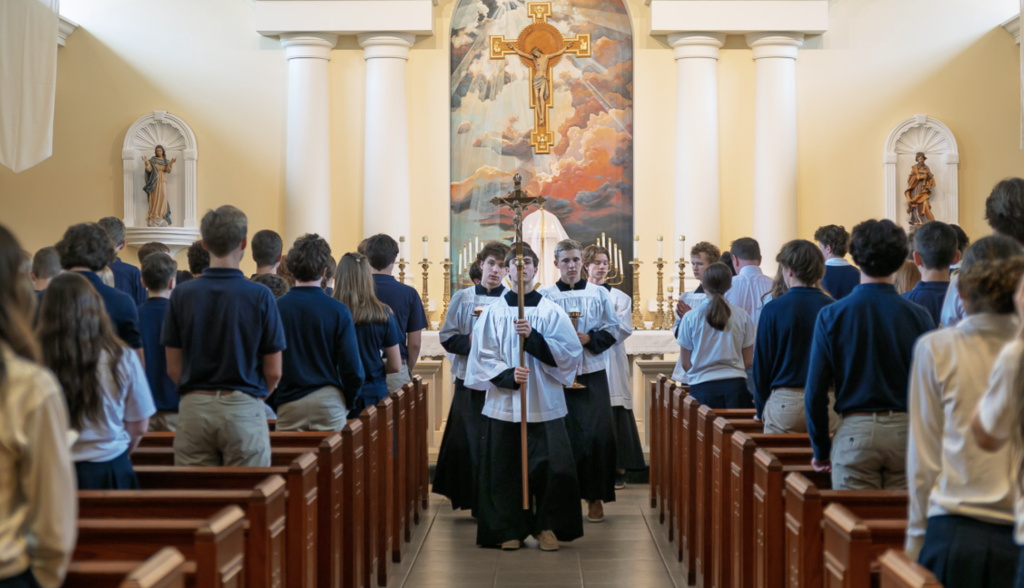
A robust program of spiritual formation nurtures the life of grace through daily communal and personal prayer, frequent opportunities for the sacraments, and full participation in the liturgical life of the Church. Passing on the faith means passing on a culture, a way of life shaped by prayer, tradition, and the rhythms of the liturgical year.
Teaching students the prayers of the Church enables them to pray not only as individuals, but also as members of the Body of Christ. Celebrating the liturgical calendar tells us what we rejoice in, what we mourn, and where we place our hope. Sharing life with the Church through the liturgical year creates a distinctive and vibrant Catholic culture in our schools.
Pillar Four: Apostolic Discernment
St. John Neumann reminds us: “Everyone who breathes…has a mission, has a work. We are not sent into this world for nothing…God sees every one of us; He creates every soul for a purpose. He needs, he deigns to need, every one of us.” Catholic schools, as centers of human formation, must help students recognize their God-given purpose. While service projects are common in Catholic education, intentionally connecting them to instruction of the corporal and spiritual works of mercy opens doors for the Holy Spirit to stir the hearts of students toward their unique vocation. Additionally, creating opportunities for students to interact with priests, deacons, religious sisters and brothers, and married couples allows them to learn about each vocation and to begin the discernment of their own vocation.
As Catholic schools build and strengthen each of these four pillars, the culture, faith, and life of the school become unified, producing a “clear identity, not only as a presence of the Church in society, but also as a genuine and proper instrument of the Church. It is a place of evangelization, of authentic apostolate, and of pastoral action.” 4
Learn more about the Catholic schools of the Archdiocese of Saint Paul and Minneapolis: spmcatholicschools.org.
1 Yeast or Frosting: Two Competing Visions of Catholic Education
2,3,4, The Religious Dimension of Education in a Catholic School (https://www.vatican.va/roman_curia/congregations/ccatheduc/documents/rc_con_ccatheduc_doc_19880407_catholic-school_en.html